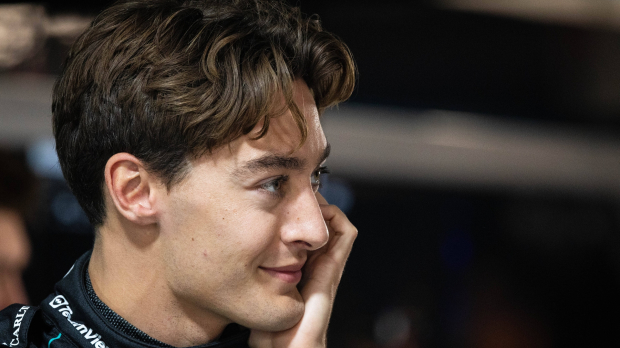
Russell trails Antonelli by 68 points, and Monaco laid bare a driving-style mismatch with the 2026 Mercedes. The Race's Mark Hughes and Peter Windsor explain why — and why it dents the case for signing Verstappen.
George Russell sits 68 points behind his 19-year-old Mercedes team-mate Kimi Antonelli, and Monaco made it impossible to file the gap under bad luck alone. Russell has lost points he should have banked this year — a battery failure while leading in Canada, a safety-car cycle that cost him the win in Japan, and a baffling Mercedes miscommunication at Monaco that turned an unserved pit-lane penalty into a drive-through and a likely podium gone. But beneath the misfortune is something more uncomfortable for Russell: the 2026 car appears to suit the way Antonelli drives, not the way he does.
Russell admitted as much over the Monaco weekend. For the first time he pointed to "something in my driving style" that is not helping the car at the moment while "playing into Antonelli's hands," adding that the difference in how the two of them drive "has such an impact on the tyres." It was a striking concession from a driver who, twelve months ago, was regularly the quicker Mercedes.
The Race's Mark Hughes laid out why. Russell's natural style is high-commitment smoothness — brake early, stabilise the car, then carry big speed through the corner. That approach was lethal in the ground-effect era and during his Williams years, and Hughes is careful to stress that "economy and smoothness should not be mistaken for conservatism." The problem is that the lower-downforce 2026 cars slide far more, and a driver now has to manage constant micro-slides. By The Race's reading, Russell loads the rear tyres harder on turn-in, struggles to get the fronts into their temperature window, and ends up overheating the rears — exactly the trait that wrecks a lap on these cars.
Hughes drew a pointed comparison: Russell has "a touch of the Oscar Piastri about him," referencing the deficiency that helped trigger Piastri's late-2025 title collapse on lower-grip surfaces. Antonelli, by contrast, is aggressive but precise — plenty of inputs, all subtle, ideal for feeling the car through a corner and reacting to slides he hasn't even arrived at yet. On the current cars, that is the more valuable toolkit.
The timing matters because it reframes the question hanging over Mercedes: whether to chase Max Verstappen for 2027. Peter Windsor argued the maths no longer favours a move. "If you've got Kimi Antonelli, more importantly, why do you need Max Verstappen?" he said. "Because Kimi can basically do the job that Max can do in that car." Windsor's advice to Toto Wolff was blunt: "If I was Toto Wolff I wouldn't touch too much of what he's got at the moment." He framed the present Mercedes as a well-balanced pairing — a generational talent leading the championship with a strong number two behind him — and warned that dropping Verstappen into the other seat would invite first-corner fireworks. "They won't be mates at the end of that year, I can tell you that," Windsor said.
Not everyone reads it the same way. Windsor conceded Verstappen himself might relish the challenge of beating Antonelli head-to-head, and that from a pure-spectacle standpoint, "bring it on." The disagreement is really about appetite for risk: keep a points-scoring machine intact, or gamble it for the sport's best driver and the volatility that comes with him.
For Russell, the more pressing fix is closer to home. Barcelona, a circuit that punishes a car that won't keep its tyres alive, is next — and it will tell him quickly whether the Monaco diagnosis was a one-off or the shape of his season.
---
*Originally published on [News Formula One](https://newsformula.one/article/russells-driving-style-trap-why-antonelli-keeps-pulling-away). Visit for full coverage.*