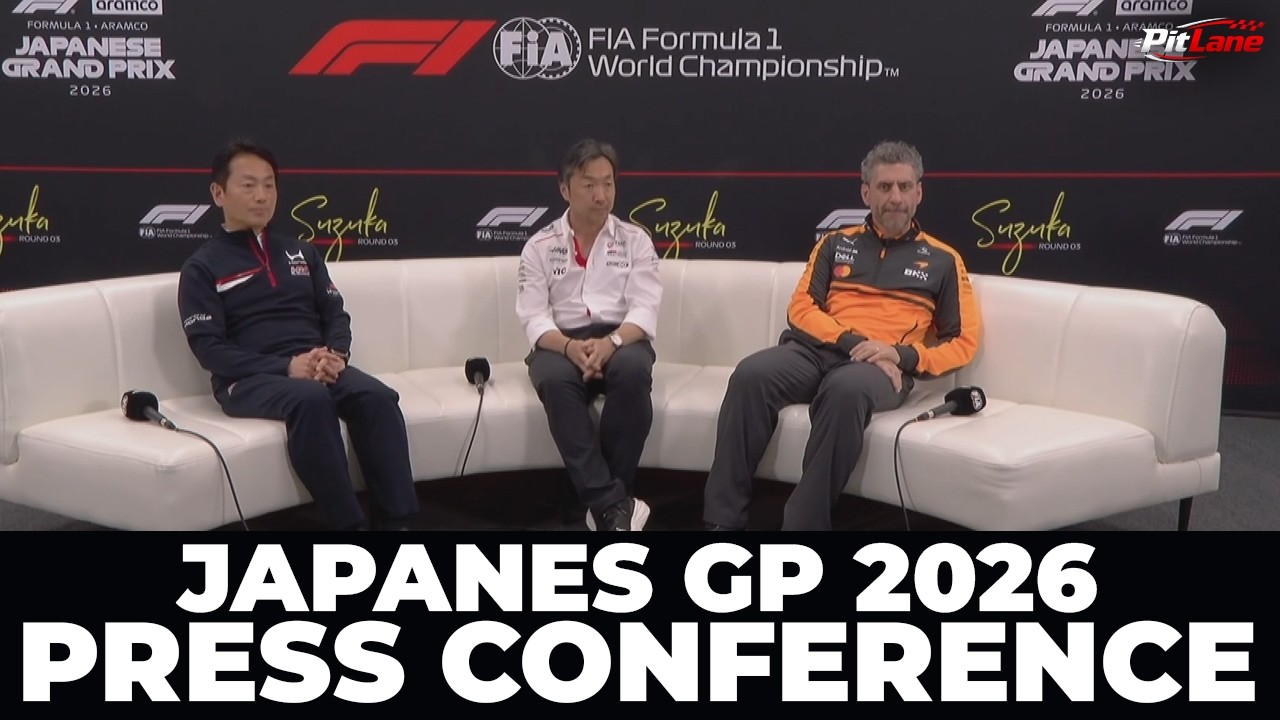
In the team principals' press conference at Suzuka, Honda Racing Corporation president Koji Watanabe gave an unusually candid explanation for the Japanese manufacturer's slow start to the 2026 power unit era.
Honda returned to the front of Formula 1's team principals' press conference at Suzuka for the first time in the 2026 era, and for once the conversation was not triumphal. Honda Racing Corporation president Koji Watanabe was asked directly why the factory Aston Martin-Honda partnership has looked second best, and he offered an unusually precise public explanation.
"I believe that there are several reasons," Watanabe said, speaking through carefully chosen English. "And the first one is that a new power regulation is quite challenging for us. The second one is that we stopped the Formula 1 activities at the end of 2021 and announced to return to Formula 1 in 2023. So there are some period during which our Formula 1 activity was quite limited."
It is the second half of that answer that will sting Honda engineers most. Between Max Verstappen's 2021 title and the formal confirmation of the Aston Martin works deal in 2023, Honda was operating in a twilight zone — officially absent from F1 at a manufacturer level, while still supporting Red Bull Powertrains on a technical basis. The company did not run a full-scale 2026 development programme during those years because, in its own words, there was no longer a Honda F1 programme to run.
The 2026 regulations, with their 50:50 split between combustion and electrical power and their dramatic new energy-recovery and deployment rules, are arguably the biggest technical reset F1 has ever attempted. Every manufacturer has acknowledged the difficulty. But Honda effectively started from behind on two fronts: a new set of rules, and a missing phase of development that its rivals — particularly Mercedes HPP and Ferrari — were able to use while still racing.
It is an admission that helps explain the on-track picture. Aston Martin, still chasing the downforce gains promised by Adrian Newey's design philosophy, has been unable to mask a power unit that sits at the back of the manufacturer fight. Fernando Alonso and Lance Stroll have both described deployment limitations mid-race, and internal estimates within the paddock put the Honda power unit several tenths adrift of the Mercedes benchmark on energy-hungry tracks.
Watanabe's honesty also sets a baseline for expectations. By framing Honda's deficit as a structural timeline problem rather than a fundamental engineering one, he is signalling to Honda's domestic audience — and to the Aston Martin boardroom — that the recovery curve is a matter of accumulated running, not a scrapped concept.
The context at Suzuka made his words sharper. Honda was addressing the media at the one race of the year where its national identity is inseparable from its performance. Japanese fans filled the Suzuka stands, many in Red Bull blue from the Verstappen era, the rest watching the new factory Aston Martin-Honda livery with cautious hope.
"During that period our Formula 1 activity was quite limited," Watanabe repeated, in case the point had been missed.
For Honda's rivals, the admission is a preview of the next eighteen months. A manufacturer publicly pinning its deficit on missing development time is a manufacturer signalling that it expects to close the gap once that time is made up. For Aston Martin, whose 2026 season is already being measured in fractions, it is both a diagnosis and a promise.
---
*Originally published on [News Formula One](https://newsformula.one/article/honda-watanabe-why-were-struggling-2026-f1-japan-admission). Visit for full coverage.*